
How to Set Up a Dartboard at Your Venue
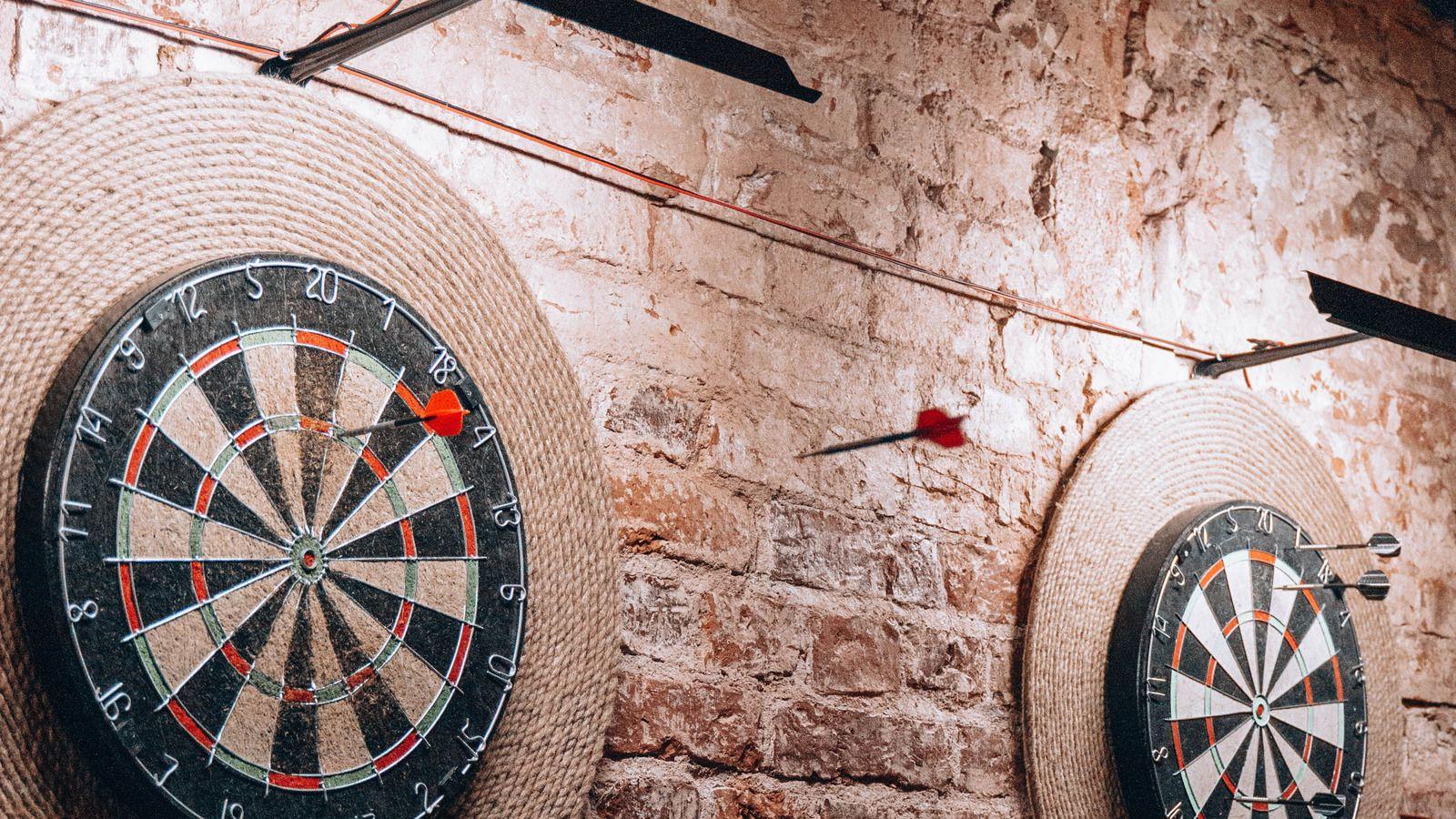
A dartboard is one of the cheapest things a pub or club can add, and one of the easiest to get wrong. A board hung too high, in a dark corner or across the path to the toilets gets used once and then ignored. Set up properly, it gives people a reason to stay for another drink and gives a local team or a social night somewhere to play.
This guide is for venue managers and club volunteers. It's mostly about putting up a steel tip board, the traditional bristle board, with a section on placing a soft tip machine. It covers where to put the board, the measurements, lighting, protection and upkeep.
Choose the spot first
The spot matters more than the board. Look for a place where:
- Nobody walks through the throw. The lane between the player and the board shouldn't cross a doorway, a walkway or the way to the bar or toilets.
- Nobody sits beside the board. Darts bounce out. Keep tables, stools and standing drinkers clear of the wall around it.
- There's room to throw. You need the throw distance, about a metre of clear space behind the throw line for the player, and enough width for a second player to stand and wait.
- The floor is level from the board to the throw line.
- Nothing fragile is close. Keep the board away from windows, mirrors, screens and glass shelves.
If you're putting up more than one board, allow about 1.8 metres between the centres of the boards, so that two games can run side by side.
The measurements
These are the standard measurements used in pubs and leagues.
Measurement | Steel tip | Soft tip machine |
|---|---|---|
Floor to the centre of the bullseye | 1.73 m (5 ft 8 in) | 1.73 m (5 ft 8 in) |
Face of the board to the throw line, along the floor | 2.37 m (7 ft 9¼ in) | 2.44 m (8 ft), including the machine's base |
Centre of the bullseye to the throw line, on the diagonal | 2.93 m (9 ft 7⅜ in) | About 2.98 m (9 ft 9½ in) |
Three things catch people out with a steel tip board:
- Measure from the face of the board, not the wall. A board is about 4 centimetres thick, and a backboard or cabinet adds more. Hang a plumb line or hold a level against the face of the board, mark the floor below it and measure from that mark.
- Measure to the edge the toes stop at. With a raised strip, the player's foot sits against the edge nearest them, so measure to that edge, the one furthest from the board. With a tape or painted line, put the edge nearest the board at 2.37 metres.
- Check with the diagonal. Run a tape from the centre of the bullseye to the throw line. If it reads 2.93 metres, the height and the distance are both right.
The 20 goes at the top, and it sits on a black segment.
Soft tip machines: measure on the diagonal
The standard throw distance for soft tip is 2.44 metres (8 ft), measured along the floor from the face of the board. The bullseye is at the same height as steel tip, 1.73 metres.
A soft tip machine is a cabinet, though, and its base sticks out in front of the board. That makes the 2.44 metres hard to measure from the face of the board. The clear floor between the front of the base and the throw line is shorter than 2.44 metres, and how much shorter depends on the machine, because each model has a different base.
So machines are usually set up by the diagonal. Run a tape from the centre of the bullseye to the floor at the throw line. The standard is about 2.98 metres (9 ft 9½ in).
Check the installation guide for your machine as well. It gives the diagonal, and usually the distance from the front of the base to the throw line for that model. Don't copy that floor distance from another machine.
If an operator supplies the machine, they'll normally place it and mark the line for you.
Mark the throw line
The throw line is called the oche. A strip of tape will do for a week. For something that lasts, use a darts mat with the line printed on it, a painted line or a raised strip fixed to the floor. A raised strip is easier for players, because they can feel it with a foot without looking down.
Make it at least as wide as the board, and square to the wall.
Fix the board so it doesn't move
A board that rocks or turns when a dart hits it is unpleasant to play on. Fix the bracket into something solid, such as a wall stud, masonry or a timber backboard, and not into plasterboard alone. Most boards hang on a centre screw with small feet at the back that hold the board flat and stop it turning. Adjust them until the board sits firm against the wall.
Protect the wall and the floor
Players miss, including the good ones.
- Wall. Fit a surround, which is a padded ring that sits around the board, or mount the board on a backboard or in a cabinet. All three catch stray darts and save the plaster.
- Floor. Tiles and concrete blunt the points and break darts. Timber gets marked. A darts mat protects both and marks the throw line as well.
Light it properly
Poor lighting is the most common fault in pub set-ups. The board should be bright and evenly lit, and the darts already in the board shouldn't throw shadows across the segments.
- A ring light that fits around the board gives even light with no shadows, and is the simplest answer.
- Otherwise use two lights, one from each side above the board, angled onto the face.
- Avoid a single light behind or directly above the player. It puts the player's shadow, or the dart's, on the board.
- Check from the throw line that no light shines into the player's eyes.
Scoring
Put a scoreboard beside the board, close enough to read from the throw line and outside the area where darts land. A chalkboard or whiteboard works. So does a tablet or phone stand, if your regulars score with an app. Keep chalk or markers there, with a cloth.
House darts
Most casual players don't own darts. Keep a few sets of steel tip darts behind the bar, with spare flights and stems, which are the parts that break. Darts of 22 to 24 grams suit most people.
A soft tip machine needs power and its own soft tip darts, and it's usually supplied and serviced by an operator. See steel tip, soft tip and electronic darts explained for the difference.
Look after the board
A bristle board lasts much longer with a little care:
- Turn it regularly. Most throws land around the 20, so that part wears first. The number ring comes off. Turn the board so that a fresh black segment is at the top, then put the ring back with the 20 over it. In a busy venue, do it every week or two.
- Never wet it. Water and cleaning spray make the fibres swell and the board bulge.
- Pull darts out with a slight twist. It's kinder to the fibres than pulling straight.
- Replace it when it's finished. If the wires are loose, the segments bulge or darts fall out of the 20, it's time for a new board.
Tell people it's there
A board only brings people in if they know about it. People search for pubs with dartboards near them, and they check before they travel.
- If your venue is already on Dartboard Finder, claim it and check that the number and type of boards are right.
- If it isn't, add the venue.
Both are free, and new listings are checked before they go live. The form asks how many steel tip and soft tip boards you have. If you lend house darts, say so in the description or the note.
Once the board is up, a regular night is the next step. See how to run a social darts night at your pub or club.
More for organisers: see what's free for venues, clubs, leagues and competitions.